
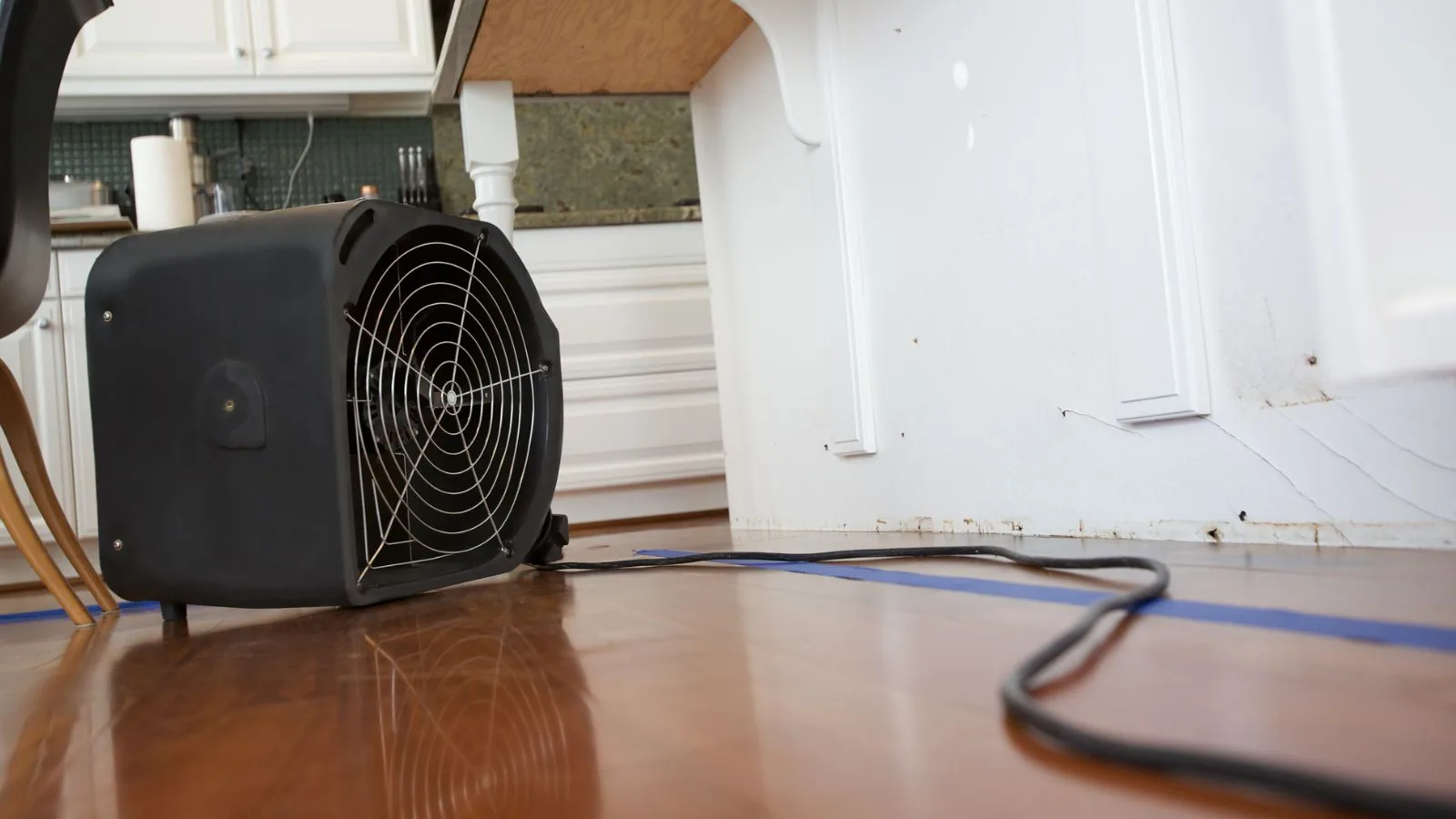
Water under a kitchen sink, behind a dishwasher or beneath a refrigerator spreads into the cabinets and subfloor before it reaches the open floor. In Syosset kitchens that means the damage is often larger than the puddle you find.
Kitchen water damage restoration covers finding the wet areas under cabinets, drying the subfloor and toe-kick, and removing materials that cannot be saved. It also documents the loss so the kitchen can be rebuilt on a dry base.
What makes kitchen water damage different
A kitchen has more places for water to hide than almost any other room. Cabinets sit on the floor, so water gets underneath and into the toe-kick. Appliances sit against walls, and supply lines run behind them. Granite or quartz counters over particleboard cabinets can hide a leak for weeks.
The materials matter. Solid wood cabinet boxes can often be dried, while particleboard and MDF swell and lose strength when they get wet, and they generally have to be replaced.
Where kitchen leaks start
- Sink supply lines and drain connections, which leak slowly into the cabinet base.
- Dishwasher supply lines, door seals and drain hoses.
- Refrigerator ice maker and water filter lines.
- Faucets and garbage disposal fittings.
- Pipes in the wall behind the sink, which can leak into the cavity.
The telltale signs are a swollen cabinet base, a soft or discolored floor at the sink, a musty smell when the cabinet is opened and a dishwasher that sits slightly unlevel on warped flooring.
How the work is done
The crew uses moisture meters to map the wet area across the cabinet base, the subfloor and the adjacent walls. Standing water is extracted, and the toe-kick is usually removed to give drying access. Where cabinets cannot stay in place, they are detached and protected, or removed if the materials are swollen.
Drying equipment is then placed, with air directed under cabinets and into wall cavities where needed. Moisture readings are taken each visit, and a hardwood or tile floor is checked for movement. If appliance water is the cause, the drying approach matches what is described under appliance leak water damage.
| Material | Wet response | Typical outcome |
|---|---|---|
| Solid wood cabinet box | May swell but can recover | Often dried in place |
| Particleboard or MDF cabinet | Swells and weakens | Usually replaced |
| Tile over a cement base | Resists water but the subfloor may not | Check the subfloor under the tile |
| Hardwood or laminate | Cups, buckles and lifts | See hardwood floor water damage repair |
Water under the sink or behind the dishwasher? Call and describe what is wet.
Cost factors and what to tell your insurer
- Cabinet materialsWood versus particleboard changes what is dried and what is replaced.
- Hidden spreadWater under cabinets and in walls takes longer to map and dry.
- FlooringTile, vinyl, laminate and hardwood each need a different approach.
- Source and durationA slow leak has often done more damage than a one-day leak.
Insurance policies commonly separate sudden leaks from gradual seepage, and cabinets and counters are a large part of kitchen claims. Keep photos of the damage, the appliance model and moisture readings, and ask your insurer how your policy applies.
If a kitchen leak started with a supply line, the process also resembles burst pipe water damage, and wet walls are covered in wall and drywall water damage repair.
What to do before the crew arrives
Whatever the cause, a few safe steps taken while you wait help the crew and your insurer. These apply to kitchen water damage restoration as much as to any other water loss.
- Stop the source if you can reach it safely, usually by closing the main water valve.
- Stay out of standing water near outlets, appliances or the electrical panel, and call 911 or the utility if you see sparks or smell gas.
- Keep children and pets out of water that may be dirty, and do not run household vacuums or fans through it.
- Take photos and video of the damage and the source before anything is moved.
- Do not throw out wet materials until your insurer or the crew has seen them.
Professional drying and cleanup of this kind follow the ANSI/IICRC S500 standard for water damage restoration, which is why the crew records moisture readings and sets drying goals instead of guessing. If mold is found, work follows the S520 standard and New York's licensing rules.
Questions people ask about this service
Can wet kitchen cabinets be saved?
Solid wood boxes can often be dried. Particleboard and MDF that have swollen usually cannot. A moisture reading and an inspection decide.
How do I know if water is under my kitchen floor?
Look for soft or bouncy flooring, a cabinet that smells musty, a swollen toe-kick or a dishwasher that has shifted. A moisture meter confirms it.
Do I need to remove the countertops?
Usually not. Counters are typically left in place, and drying focuses on the cabinet base, toe-kick, floor and walls, unless the damage reaches the counter support.
Is a small kitchen leak worth drying?
Yes. Small leaks wet more than they show, and left damp they can swell cabinets, rot subfloor and grow mold.
Can I just replace the damaged floor?
Replacing the flooring before the subfloor and cabinet base are dry traps moisture. Dry first, then rebuild.
Water still moving? The line is open 24/7.
Call (833) 521-1033