
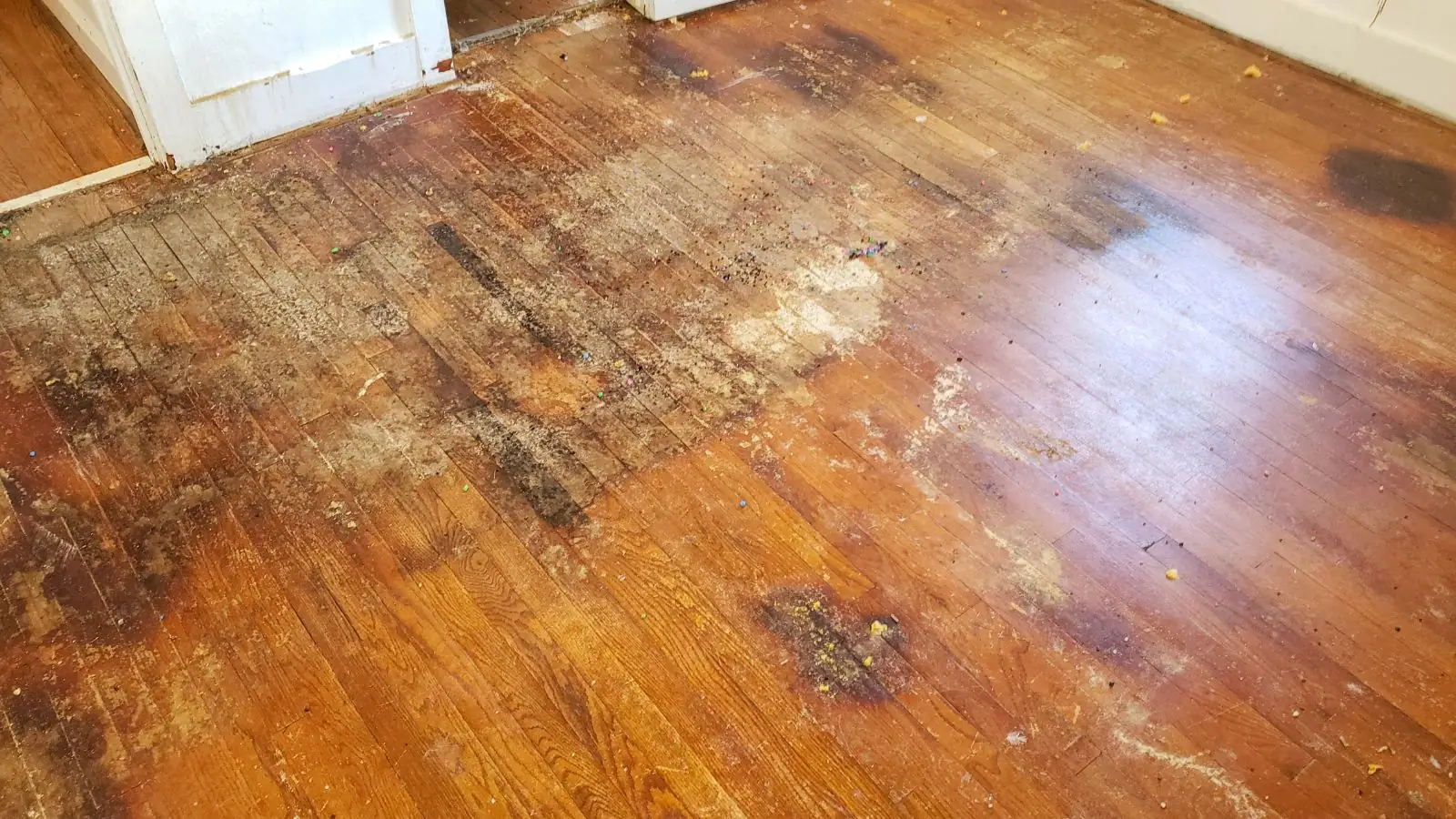
Hardwood absorbs water, and when it does it cups, crowns and buckles. In Syosset homes with hardwood floors, how quickly the drying starts often decides whether the floor can be saved.
Hardwood floor water damage repair starts with drying the boards and the subfloor with specialized equipment, then judging whether the floor can be sanded and refinished or needs replacement. Moving fast and measuring moisture are what separate a recovered floor from a lost one.
What water does to a wood floor
Wood swells when it takes on moisture, and the edges of boards swell first. That produces cupping, where the board edges rise above the center. Crowning is the opposite, with the center higher than the edges, and it usually appears after the floor has been dried or sanded too early. Buckling is the most severe form, where boards lift off the subfloor.
Water also gets underneath. Tongue-and-groove boards trap moisture between boards and in the subfloor, so a floor can look nearly normal on top while the layer below is saturated.
Drying hardwood: the specialized approach
Standard fans are not enough for wood. Technicians use drying mats or panels that pull moisture up through the boards, along with dehumidifiers to remove it from the air. In some cases, a few boards are removed to allow airflow into the subfloor, which speeds drying and prevents trapped water.
Moisture readings are taken on the surface and in the subfloor, compared with a dry reading from an undamaged area. The floor is considered dry only when readings return to that reference level, which can take days.
| Condition | What it means | Likely path |
|---|---|---|
| Slight cupping, no buckling | Boards absorbed water but are still attached | Dry thoroughly, then sand and refinish if flat |
| Cupping with staining | Water sat on the floor for a longer time | Dry, assess, refinish or replace stained boards |
| Buckling or lifting | Boards separated from the subfloor | Often partial or full replacement |
| Black staining at joints | Long-term moisture or mold | Replace affected boards, see mold remediation |
Refinish or replace: an honest trade-off
If cupping is mild and the floor dries flat, sanding and refinishing can restore it, and it is often the least costly outcome. Sanding too soon is the usual mistake, because it flattens a cupped floor that later shrinks and crowns. Waiting until the floor is dry avoids that.
Engineered hardwood and laminate behave differently from solid wood. Engineered floors with a thin top layer can delaminate, and laminate usually swells at the seams and has to be replaced.
Hardwood cupping or lifting after a leak? Call as soon as you notice. Timing matters.
Cost factors and insurance
- Wood typeSolid, engineered and laminate floors respond differently.
- Time wetThe earlier drying starts, the more likely the floor is saved.
- SubfloorA wet subfloor can slow drying and may need attention.
- Finish and areaRefinishing a whole connected area costs differently than patching a section.
Policies usually address sudden water loss, but gradual leakage and wear can be treated differently. Keep dated photos, moisture readings and any flooring details, such as the wood type, and ask your insurer what applies.
Hardwood losses often start with an appliance leak or a burst pipe, and the drying principles are covered in structural drying and dehumidification.
What to do before the crew arrives
Whatever the cause, a few safe steps taken while you wait help the crew and your insurer. These apply to hardwood floor water damage repair as much as to any other water loss.
- Stop the source if you can reach it safely, usually by closing the main water valve.
- Stay out of standing water near outlets, appliances or the electrical panel, and call 911 or the utility if you see sparks or smell gas.
- Keep children and pets out of water that may be dirty, and do not run household vacuums or fans through it.
- Take photos and video of the damage and the source before anything is moved.
- Do not throw out wet materials until your insurer or the crew has seen them.
Professional drying and cleanup of this kind follow the ANSI/IICRC S500 standard for water damage restoration, which is why the crew records moisture readings and sets drying goals instead of guessing. If mold is found, work follows the S520 standard and New York's licensing rules.
Questions people ask about this service
Can a water damaged hardwood floor be saved?
Often yes, if drying starts quickly and the water was clean. Severe buckling, long exposure or contamination reduces the chances.
How long before I can refinish a wet floor?
Not until moisture readings return to normal in the boards and subfloor. That can take days or weeks, depending on how wet it was.
Why is my floor cupping after the leak was fixed?
The boards absorbed water unevenly, and the underside holds more. As the floor dries, cupping can ease or become permanent, which is why measured drying matters.
Is engineered hardwood the same as solid wood in a leak?
No. Engineered boards have a thin wear layer over plywood, and they can delaminate or swell. Some can be dried, many cannot.
Can I use fans to dry my hardwood floor?
Fans alone are rarely enough. The water trapped between boards and in the subfloor needs controlled drying with mats or panels and dehumidifiers.
Water still moving? The line is open 24/7.
Call (833) 521-1033